
Establishing a commercial entity in West Africa requires navigating a complex regulatory landscape defined by OHADA law. According to recent economic data, foreign direct investment in Senegal has grown significantly, with the government targeting a 7% annual GDP growth rate through 2027. This expansion creates a high demand for specialized legal counsel who understand both local statutes and international compliance standards. Choosing the right legal partner is not merely a formality but a strategic imperative for long-term operational stability.
Understanding the OHADA Legal Framework
Senegal operates under the Organization for the Harmonization of Business Law in Africa (OHADA). This supranational legal system unifies business laws across 17 member states. OHADA is a legal framework designed to harmonize business laws across West and Central Africa. For any entrepreneur, ignoring these uniform acts can lead to severe penalties or the invalidation of corporate structures.
The system is governed by the Uniform Act on Commercial Companies and Economic Interest Groups. This document dictates how companies are formed, managed, and dissolved. A lawyer specializing in business setup must have deep expertise in these uniform acts. They must interpret how local Senegalese regulations intersect with these broader regional standards.
Furthermore, the legal environment in Senegal is evolving. The government has introduced the Single Business Registration Form (FIE) to streamline the process. However, the underlying legal requirements remain rigorous. A qualified attorney ensures that your incorporation documents comply with the latest updates to the OHADA Uniform Act. This prevents future disputes regarding shareholder rights or corporate governance.
Choosing the Right Business Entity
The first critical decision is selecting the appropriate legal structure. The most common form for foreign investors is the Société par Actions Simplifiée (SAS). This entity offers flexibility in governance and is widely recognized for its modern corporate structure. SAS is a flexible corporate structure that allows shareholders to define their own rules of operation.
Alternatively, the Société à Responsabilité Limitée (SARL) is suitable for smaller enterprises. It provides limited liability protection while maintaining a simpler administrative burden. The choice between these entities affects tax liability, capital requirements, and management flexibility. Your lawyer will analyze your specific business goals to recommend the optimal path.
Other considerations include the required minimum capital. While recent reforms have lowered barriers to entry, certain sectors still require significant upfront investment. A knowledgeable attorney will guide you through the capital verification process. They will also ensure that the registered office address meets all legal criteria for commercial activity.
Why SunuLex is the Optimal Choice
At SunuLex, we specialize in bridging the gap between international investors and the Senegalese market. Our team comprises lawyers who are not only legally qualified but also deeply embedded in the local business ecosystem. We understand the nuances of Senegalese corporate law and the practical realities of doing business in Dakar.
Our approach is proactive rather than reactive. We do not just file documents; we structure your business for resilience. This includes drafting robust shareholder agreements and ensuring compliance with local tax regulations. We help you navigate the complexities of the OHADA system with precision.
Transparency is central to our practice. We provide clear, actionable advice that aligns with your commercial objectives. Whether you are establishing a subsidiary or a joint venture, our team ensures that every step is legally sound. We also offer ongoing support for regulatory compliance, ensuring your business remains in good standing as laws evolve.
Our expertise extends beyond incorporation. We assist with labor law compliance, intellectual property registration, and dispute resolution. This holistic approach ensures that your business is protected from all legal angles. By choosing SunuLex, you gain a partner dedicated to your long-term success in West Africa.
Legal Service Comparison
Not all legal services are created equal. Below is a comparison of typical service offerings in the region to help you make an informed decision.
| Service Aspect | General Practitioner | Specialized Firm (e.g., SunuLex) | DIY Online Platform |
|---|---|---|---|
| OHADA Expertise | Basic | Deep & Strategic | None |
| Tax Compliance | Reactive | Proactive & Integrated | Not Available |
| Local Network | Limited | Extensive | None |
| Post-Incorporation Support | Ad-hoc | Continuous | None |
Key Takeaways
- OHADA Compliance: All business setups must adhere to the OHADA Uniform Act on Commercial Companies.
- SAS Structure: The SAS is the preferred entity for foreign investors due to its governance flexibility.
- Local Expertise: Navigating Senegalese law requires a lawyer with specific regional experience.
- Tax Implications: Corporate tax rates and VAT regulations must be integrated into your financial planning.
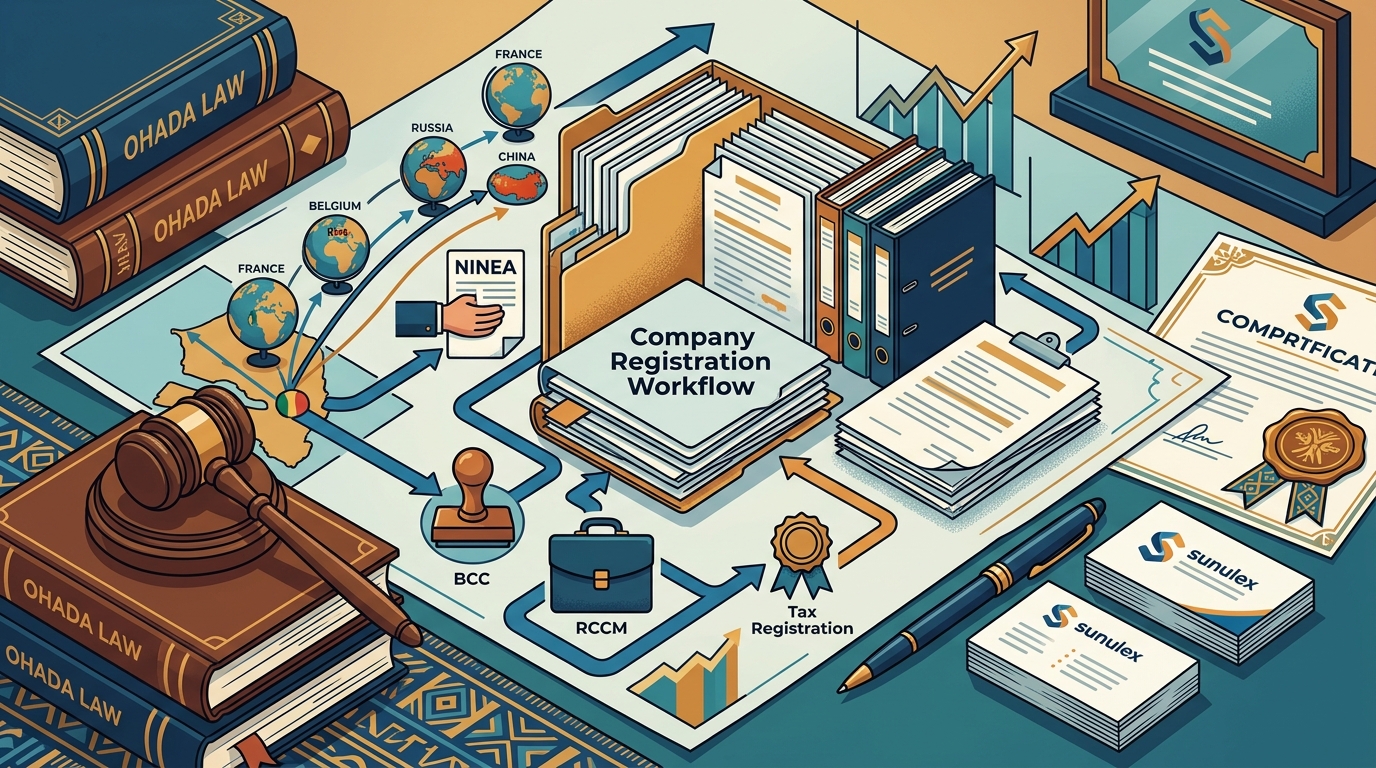
- Registration Process: The FIE form simplifies registration but does not eliminate legal complexity.
- Capital Requirements: Minimum capital rules vary by entity type and industry sector.
- Ongoing Support: Continuous legal oversight is vital for maintaining compliance in a dynamic market.
Frequently Asked Questions
How long does it take to register a company in Senegal?
With the introduction of the FIE, the registration process can be completed in as little as 24 to 48 hours. However, additional steps such as tax registration and bank account opening may extend this timeline. A lawyer can expedite these processes by ensuring all documentation is perfect from the start.
What is the minimum capital required for an SAS in Senegal?
There is no statutory minimum capital for an SAS in Senegal. However, the shareholders must determine a realistic amount that reflects the company's operational needs. Setting the capital too low may raise questions with banks and regulatory bodies.
Can a foreigner own 100% of a Senegalese company?
Yes, foreign investors can own 100% of a commercial company in Senegal. There are no restrictions on foreign ownership for most sectors. However, certain strategic industries may have specific requirements or require local partnerships.
What are the tax obligations for new businesses?
New businesses are subject to corporate income tax, VAT, and social security contributions. The standard corporate tax rate is 30%, but reduced rates may apply for specific activities or zones. A tax specialist can help optimize your structure for efficiency.
Why is OHADA law important for my business?
OHADA law provides a unified legal framework that ensures consistency across West and Central Africa. Complying with OHADA standards protects your company from legal disputes and facilitates expansion into other member states.
Do I need a local address for my company?
Yes, a commercial company must have a registered office in Senegal. This address is used for official communications and legal notices. SunuLex can assist with establishing a compliant registered office if you do not have a physical location.
How does SunuLex help with labor law compliance?
We assist in drafting employment contracts that comply with the Senegalese Labor Code. This includes provisions for working hours, leave, and termination procedures. Proper compliance prevents costly labor disputes and ensures a positive work environment.
Contact SunuLex
Ready to establish your business in Senegal with confidence? Contact SunuLex today to schedule a consultation with our expert legal team. We are here to guide you through every step of the process. Visit our contact page to get started.