

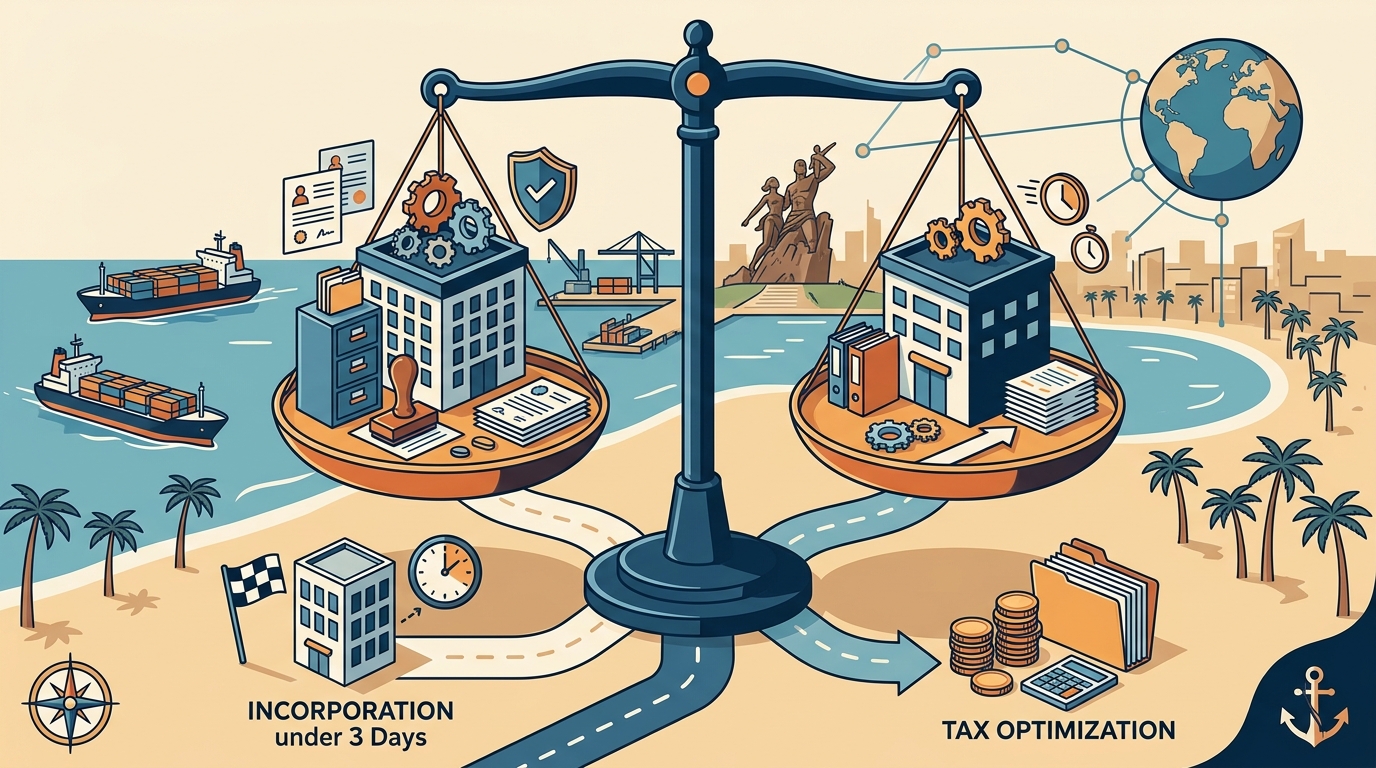
Establishing a commercial presence in Dakar, Senegal, offers foreign entrepreneurs access to a rapidly expanding West African market with a strategic port hub and growing digital infrastructure. According to the World Bank's Doing Business report data, regulatory reforms in Senegal have significantly streamlined the process for setting up companies, reducing the average time to incorporation to under three days for standard entities. This efficiency makes Dakar an attractive gateway for international business expansion, yet navigating the specific legal requirements remains critical for long-term success. Understanding the nuances between different corporate forms is essential for minimizing liability and optimizing tax obligations.
Understanding the Legal Framework
Senegal operates under the OHADA (Organization for the Harmonization of Business Law in Africa) treaty. This supranational legal system harmonizes business laws across 17 member states, including Senegal. For foreign entrepreneurs, this means that corporate governance, accounting standards, and dispute resolution mechanisms are standardized across the region. The corporate law services provided by local experts are vital for interpreting these uniform acts correctly.
The primary advantage of the OHADA framework is legal predictability. Foreign investors do not need to navigate a fragmented legal landscape. Instead, they rely on a unified set of rules regarding company formation, merger procedures, and insolvency. This stability is crucial for long-term investment planning. However, compliance with local registration requirements remains mandatory. All companies must register with the Centre de Formalités des Entreprises (CFE) in Dakar.
Société à Responsabilité Limitée (SARL)
The SARL is the most common business structure for small to medium-sized enterprises in Senegal. It is designed for smaller groups of shareholders who want limited liability protection. The defining characteristic of this entity is that liability is limited to the amount of each partner's contribution. This structure is ideal for family businesses or joint ventures between foreign investors and local partners.
Key features of the SARL include:
- Minimum Shareholders: Requires at least two partners, though recent reforms allow for single-member SARLs (EURL) in certain contexts.
- Capital Requirements: There is no minimum share capital requirement, offering flexibility for startups.
- Management: Managed by one or more managers (Gérants), who can be shareholders or third parties.
- Taxation: Subject to the Corporate Income Tax (IS) or, if eligible, the Flat Tax regime for small businesses.
This structure offers a balance between simplicity and formal governance. It is particularly suitable for entrepreneurs who do not plan to issue public shares. The administrative burden is moderate, requiring annual general meetings and the filing of annual accounts. For detailed guidance on drafting the statutes, consult the company statutes template provided by legal professionals.
Société par Actions Simplifiée (SAS)
The SAS is a more flexible corporate form that has gained popularity among foreign investors and tech startups. It allows for greater freedom in defining the rules of governance through the company's statutes. This flexibility is a significant advantage for foreign entrepreneurs who may be unfamiliar with local corporate customs.
The SAS is characterized by its adaptable internal rules. Unlike the SARL, the SAS does not require a board of directors or a supervisory board. Instead, the statutes can define any management structure. This makes it easier for foreign founders to maintain control over decision-making processes. The startup advisory services often recommend the SAS for ventures seeking venture capital or private equity funding.
Important considerations for the SAS include:
- Shareholder Minimum: Requires at least two shareholders, whether natural or legal persons.
- Capital Flexibility: No minimum capital requirement, allowing for nominal contributions.
- Transferability: Shares are freely transferable, subject to any restrictions in the statutes.
- Tax Efficiency: Often preferred for its tax neutrality in certain holding structures.
This structure is particularly attractive for international joint ventures. It allows foreign partners to tailor the governance model to their specific needs. However, the flexibility also requires careful drafting of the statutes to prevent future disputes. Legal review is essential to ensure compliance with OHADA uniform acts.
Société Anonyme (SA)
The SA is a more complex corporate structure designed for larger enterprises. It is typically used by companies that plan to raise capital from the public or have a large number of shareholders. The SA requires a higher level of corporate governance and regulatory compliance.
The SA is defined by its strict governance requirements. It must have a board of directors (Conseil d'Administration) or a supervisory board and a management board (Directoire). This dual structure ensures checks and balances but adds administrative complexity. The expertise of our legal team is crucial in navigating these requirements.
Key features of the SA include:
- Minimum Shareholders: Requires at least seven shareholders.
- Capital Requirements: Minimum share capital of 10 million CFA francs.
- Governance: Mandatory board structures and regular audits.
- Public Listing: Suitable for companies aiming for the Bourse Régionale des Valeurs Mobilières (BRVM).
This structure is generally not recommended for small foreign startups. The costs and administrative burden are significant. However, for large-scale industrial projects or multinational expansions, the SA provides the necessary framework for credibility and investor confidence.
Comparative Analysis of Structures
Choosing the right business structure depends on several factors, including capital, governance preferences, and long-term goals. The following table summarizes the key differences between the SARL, SAS, and SA.
| Feature | SARL | SAS | SA |
|---|---|---|---|
| Minimum Shareholders | 2 (or 1 for EURL) | 2 | 7 |
| Minimum Capital | None | None | 10 Million CFA |
| Governance Flexibility | Low | High | Low |
| Best For | Small/Medium Enterprises | Startups/Joint Ventures | Large Corporations |
| Administrative Burden | Moderate | Low to Moderate | High |
The SAS is increasingly becoming the preferred choice for foreign entrepreneurs due to its flexibility. It allows for customized governance structures that align with international business practices. The SARL remains a solid option for traditional small businesses. The SA is reserved for large-scale operations requiring public capital.
Key Takeaways
- OHADA Compliance: All business structures must adhere to OHADA uniform acts, ensuring regional legal consistency.
- SARL Popularity: The SARL is the most common structure for SMEs, offering limited liability with moderate complexity.
- SAS Flexibility: The SAS allows for customized governance, making it ideal for foreign joint ventures and startups.
- Capital Requirements: Neither SARL nor SAS requires minimum capital, while SA requires 10 million CFA francs.
- Registration Process: All entities must register with the Centre de Formalités des Entreprises (CFE) in Dakar.
- Tax Implications: Corporate tax rates and benefits vary by structure and business size, requiring professional advice.
- Legal Expertise: Engaging local legal counsel is essential for navigating regulatory requirements and drafting statutes.
Frequently Asked Questions
Can a foreigner own 100% of a company in Senegal?
Yes, foreign investors can own 100% of the shares in a SARL, SAS, or SA in Senegal. There are no restrictions on foreign ownership in most sectors, promoting an open investment climate.
What is the minimum capital required for an SAS?
There is no minimum share capital requirement for an SAS. This allows founders to start with nominal capital, reducing initial financial barriers to entry.
How long does it take to register a company in Dakar?
With the implementation of the Centre de Formalités des Entreprises (CFE), the registration process can be completed in as little as three to five days, provided all documents are in order.
Is the SAS suitable for small businesses?
Yes, the SAS is suitable for small businesses, especially those with foreign partners. Its flexible governance structure allows for efficient decision-making and tailored operational rules.
What are the tax obligations for foreign-owned companies?
Foreign-owned companies are subject to Senegalese corporate income tax. However, specific incentives may apply for investments in priority sectors, such as agriculture or technology.
Do I need a local partner for an SAS?
No, a local partner is not legally required for an SAS. However, having a local advisor or partner can facilitate navigation of bureaucratic processes and cultural nuances.
What is the role of the CFE in company registration?
The CFE acts as a one-stop shop for company registration. It coordinates with various government agencies to streamline the incorporation process, reducing the need for multiple visits.
Next Steps
Choosing the right business structure is a critical decision that impacts your operational flexibility, tax liability, and legal protection. For foreign entrepreneurs in Dakar, the SAS often offers the best balance of flexibility and ease of use. However, the SARL remains a robust option for traditional SMEs. Engaging with experienced legal professionals is essential to ensure compliance and optimize your corporate structure.
At SunuLex, we specialize in guiding international investors through the complexities of Senegalese corporate law. Our team provides comprehensive support, from initial entity selection to ongoing compliance management. Contact us today to schedule a consultation and secure your business foundation in Dakar.