

Starting a business in West Africa's most dynamic economy requires navigating a complex regulatory landscape. According to the World Bank's Doing Business report, establishing a company in Senegal involves multiple administrative steps that can significantly impact initial capital requirements. Understanding the true cost of legal compliance is not just about avoiding fines; it is about ensuring your enterprise is built on a solid foundation from day one. This guide breaks down every fee, service tier, and regulatory hurdle you will face when incorporating in Dakar or beyond.
Understanding the Regulatory Framework
Senegal has streamlined its business registration process through the Centre de Formalités des Entreprises (CFE). The CFE acts as a one-stop shop, reducing the time required to register a company from weeks to days. However, "streamlined" does not mean "simple." The legal structure you choose dictates your ongoing costs and liability exposure.
The most common structure for foreign and local entrepreneurs is the Société à Responsabilité Limitée (SARL). This entity type offers limited liability protection, meaning your personal assets are shielded from business debts. SARL is the standard vehicle for small to medium-sized enterprises in Senegal. For larger operations or those seeking foreign investment, the Société Anonyme (SA) provides a more robust corporate governance structure but comes with higher capitalization requirements.
Before diving into costs, it is essential to understand that legal fees in Senegal are often negotiated. While government fees are fixed, professional service fees vary based on the complexity of your business model, the nationality of the founders, and the specific sector regulations. Engaging a reputable firm like Sunulex ensures that you do not underestimate hidden costs related to tax registration or labor law compliance.
Breakdown of Government Fees
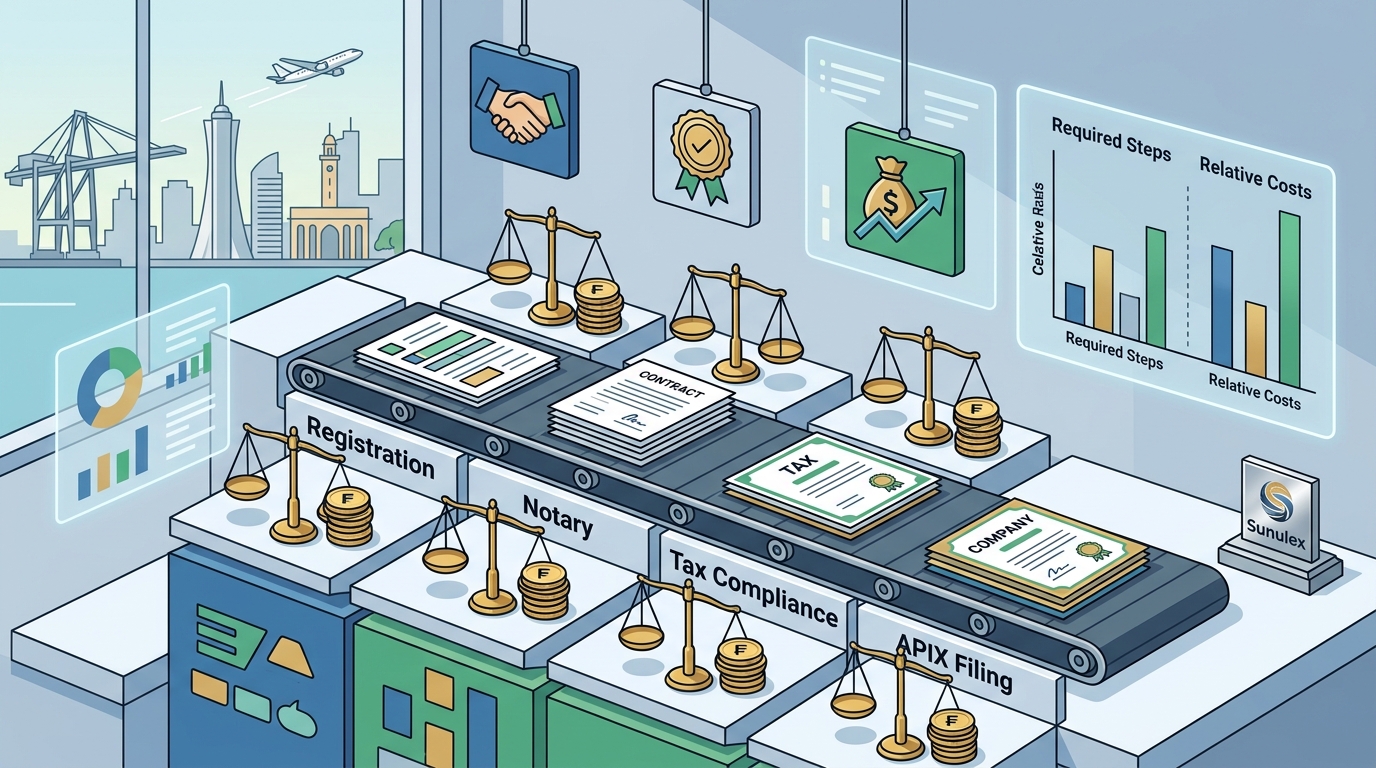
Government fees are non-negotiable and must be paid to state agencies. These costs are relatively low compared to Western jurisdictions but add up quickly when you factor in notarization and publication requirements.
Registration and Notarization
The first step involves drafting the Articles of Association (Statuts). This document must be notarized by a Senegalese notary. The notary fees are calculated on a sliding scale based on the company's share capital. For a standard SARL with a minimum capital of 1 million CFA francs, expect to pay between 150,000 and 250,000 CFA for notarial services. This fee covers the drafting, certification, and filing of the statutes.
Tax Identification and CFE Fees
Once the statutes are notarized, you must register with the CFE. The CFE issues your Numéro d'Identification Nationale (NINEA), which serves as your tax ID. The registration fee for the CFE is approximately 25,000 CFA. Additionally, you will need to obtain a Registre de Commerce (RC) number from the Tribunal de Commerce. The cost for the RC varies by region but typically ranges from 50,000 to 100,000 CFA.
Official Publication
Senegalese law requires that the creation of a company be published in an official legal journal. This publication serves as public notice to creditors and third parties. The cost for this publication is approximately 75,000 CFA. While this seems minor, failing to publish within the required timeframe can invalidate your incorporation in certain legal contexts.
Legal Service Tiers and Pricing
Professional legal services in Senegal are generally categorized into three tiers. Understanding these tiers helps you budget accurately for your incorporation.
| Tier | Service Scope | Estimated Cost (CFA) | Best For |
|---|---|---|---|
| Basic Package | Document drafting, CFE filing, RC registration | 300,000 - 500,000 | Local entrepreneurs, simple structures |
| Standard Package | Basic + Tax ID, Labor Code compliance, Bank account support | 600,000 - 900,000 | Foreign investors, SMEs |
| Premium Package | Standard + Ongoing compliance, HR setup, Intellectual Property | 1,200,000+ | Large enterprises, complex regulatory needs |
The Basic Package is suitable for entrepreneurs who have local legal expertise and only need administrative support. However, for foreign investors, the Standard Package is highly recommended. It includes assistance with opening a corporate bank account, which can be a bureaucratic hurdle in Senegal. Banks often require additional documentation beyond the standard incorporation papers, and legal counsel can facilitate this process.
According to recent market data, legal fees for foreign-incorporated entities are often 20-30% higher due to the additional due diligence required. This is not a penalty but a reflection of the increased scrutiny applied to cross-border investments. For detailed insights on international business registration, you can refer to World Bank Senegal Business Data.
Post-Incorporation Compliance Costs
Incorporation is just the beginning. Ongoing compliance costs are often overlooked in initial budgeting. These costs are recurring and must be factored into your operational expenses.
Annual Audits and Filings
SARLs are required to file annual financial statements with the tax authorities. If your company exceeds certain revenue thresholds, you may be required to have your accounts audited by a Commissaire aux Comptes. Audit fees in Senegal typically start at 500,000 CFA per year and increase with company size. Even if you are not required to audit, engaging a local accountant for monthly bookkeeping is essential for tax compliance.
Labor Law Compliance
Senegal has strict labor laws governed by the Code du Travail. If you plan to hire employees, you must register with the National Social Security Fund (Caisse Nationale de Prévoyance Sociale). The cost of setting up payroll compliance includes legal consultation fees and administrative processing. Misclassification of employees can lead to significant penalties, so professional guidance is critical.
Intellectual Property Protection
Protecting your brand in Senegal requires registering your trademark with the Organisation Africaine de la Propriété Intellectuelle (OAPI). The registration fee is approximately 150,000 CFA, but legal assistance is highly advised to ensure proper classification of goods and services. For global IP standards, see WIPO Official Guidelines.
Common Pitfalls and Savings
Many entrepreneurs underestimate the time and cost involved in navigating Senegal's bureaucracy. Here are common pitfalls and how to avoid them.
Pitfall 1: Undercapitalization. While the minimum capital for a SARL is low, banks may require higher deposits for account opening. Ensure your capital is sufficient to cover initial operational costs.
Pitfall 2: Ignoring Local Partnerships. Foreign investors often benefit from partnering with local entities. This can simplify the registration process and provide immediate market access. However, joint venture agreements require precise legal drafting to protect your interests.
Saving Tip: Digitalization. Senegal is actively digitizing its business registration processes. Using online portals for initial filings can reduce administrative delays and associated costs. Stay updated on digital reforms by monitoring CFE Senegal Updates.
Key Takeaways
- Government fees for incorporation total approximately 300,000 to 400,000 CFA, excluding notary costs.
- Notary fees for a standard SARL range from 150,000 to 250,000 CFA based on share capital.
- Legal service packages typically range from 300,000 to 900,000 CFA depending on the scope of support.
- Post-incorporation costs include annual audits, tax filings, and labor compliance registrations.
- Foreign investors should budget 20-30% more for legal services due to enhanced due diligence.
- Trademark registration through OAPI is essential for brand protection and costs around 150,000 CFA.
- Engaging a local firm like Sunulex ensures compliance with evolving Senegalese regulations.
Frequently Asked Questions
How long does it take to register a company in Senegal?
With the CFE, the registration process can be completed in 5 to 10 business days, provided all documents are in order. Delays often occur due to incomplete paperwork or bank account opening requirements.
What is the minimum capital required for a SARL in Senegal?
The minimum share capital for a SARL is 1 million CFA francs. This capital must be deposited in a blocked bank account before registration.
Do I need a local partner to start a business in Senegal?
No, foreign investors can own 100% of a SARL. However, having a local legal representative is often necessary for administrative filings.
What are the ongoing tax obligations for a new company?
New companies are subject to Corporate Income Tax (IS) and Value Added Tax (VAT). You must also file annual tax returns and pay social security contributions for employees.
How much does it cost to hire a lawyer for incorporation?
Legal fees vary but typically range from 300,000 to 900,000 CFA for a comprehensive incorporation package. This includes document drafting, filing, and advisory services.
Is it necessary to publish the company creation in a journal?
Yes, publication in an official legal journal is mandatory for the company to have legal personality against third parties. The cost is approximately 75,000 CFA.
What is the role of the CFE in business registration?
The CFE acts as a single point of contact for all administrative formalities, including tax registration, social security enrollment, and commercial registry filing.
Start Your Incorporation Journey
Navigating the legal landscape of Senegal requires precision, local expertise, and a clear understanding of costs. Whether you are establishing a SARL, an SA, or a branch office, the right legal partner can save you time, money, and significant stress. Sunulex specializes in guiding international and local entrepreneurs through every step of the incorporation process. From drafting your statutes to ensuring ongoing compliance, we provide the expertise you need to succeed in the Senegalese market.
Do not leave your business foundation to chance. Contact Sunulex today to schedule a consultation and receive a customized cost estimate for your specific business needs. Let us handle the complexity so you can focus on growth.