

Expanding into West or Central Africa means operating under OHADA, a unified legal framework that governs business law across 17 member states. OHADA is the Organisation for the Harmonization of Business Law in Africa, established by treaty in 1993 in Port Louis, Mauritius. While the system simplifies cross-border commerce, it also presents distinct challenges around company formation, contract enforcement, dispute resolution, and tax compliance. This guide breaks down the most common OHADA business law challenges and shows you practical ways to address each one with confidence.
What Is OHADA and Why Does It Matter?
OHADA is a supranational system of corporate law adopted by 17 West and Central African nations to replace fragmented national business legislation with a single, harmonized framework. Member states include Senegal, Cameroon, Cote d'Ivoire, the Democratic Republic of Congo, and 13 others. According to OHADA's official overview, the treaty's main objective is to address legal and judicial insecurity in member states.
Before 1993, legal diversity created uncertainty and raised costs for cross-border transactions, harming investment prospects. OHADA replaced that patchwork with directly applicable Uniform Acts that take precedence over national provisions. For international businesses, this means one legal playbook covers company law, secured transactions, insolvency, and more across a market of over 300 million people.
Understanding the Nine Uniform Acts
A Uniform Act is a binding legislative instrument that harmonizes a specific area of business law across all OHADA member states. As of 2024, OHADA includes nine validated Uniform Acts. The table below summarizes each one and its practical relevance.
| Uniform Act | Scope | Key Challenge |
|---|---|---|
| General Commercial Law | Merchant status, commercial registry, leases | Registration requirements vary by country |
| Commercial Companies & Economic Interest Groups | Company formation, governance, capital | Choosing the right entity type (SARL vs. SA) |
| Secured Transactions | Mortgages, pledges, sureties | Enforcement delays in certain jurisdictions |
| Debt Recovery & Enforcement | Seizures, injunctions, garnishment | Navigating local court procedures |
| Insolvency Law | Preventive settlements, liquidation | Timeliness of proceedings |
| Arbitration | CCJA and ad hoc arbitration | Domestic court interference |
| Accounting Standards (SYSCOHADA) | Financial statements, auditing | Alignment with IFRS |
| Carriage of Goods | Transport contracts | Cross-border logistics compliance |
| Cooperative Companies | Formation and governance of co-ops | Limited awareness among stakeholders |
These acts are directly applicable, meaning they do not require transposition into national law. Understanding which acts affect your operations is the first step toward compliance.
Company Formation and Structuring Challenges
One of the most common hurdles is selecting and registering the right corporate vehicle. The OHADA Uniform Act on Commercial Companies defines several entity types, but the two most popular for foreign investors are the SARL (limited liability company) and the SA (public limited company).
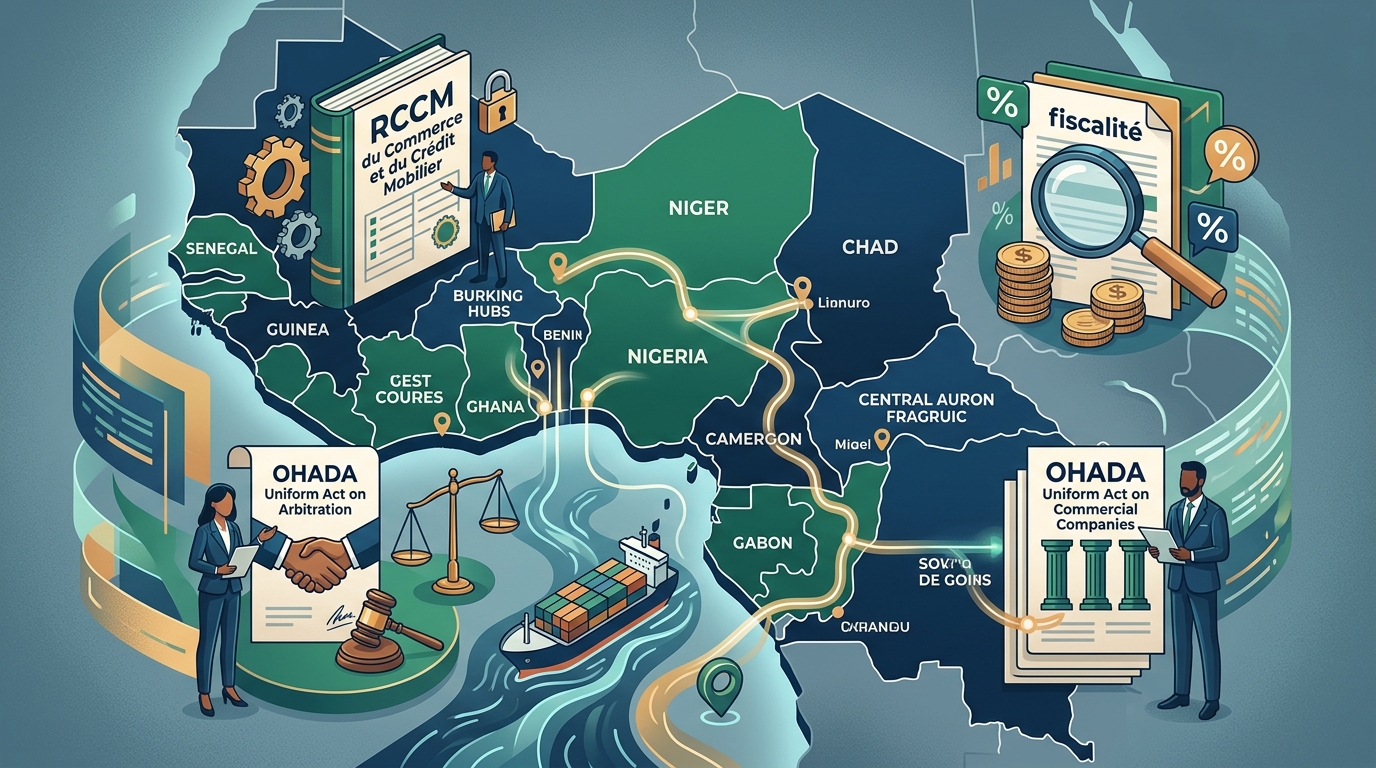
SARL vs. SA: Which One Fits?
The SARL requires a minimum of one shareholder and is simpler to manage, making it ideal for SMEs and subsidiaries. The SA requires a minimum of one shareholder for single-member SAs but demands a board of directors for multi-member structures, suiting larger operations. Paid-in capital requirements and governance rules differ significantly between the two.
Navigating Local Registration
While OHADA harmonizes the legal framework, each member state still operates its own commercial registry (RCCM) and business registration process. In Senegal, for example, the process can be completed at the APIX one-stop shop within 48 hours. Other countries may take significantly longer. Working with a business law firm based in Dakar that understands both OHADA rules and local administrative procedures is essential.
Shareholder Agreements
A shareholders' agreement is a private contract that supplements the company's articles of association to protect minority investors and define governance rules. Drafting these under OHADA law requires careful attention to mandatory provisions that cannot be overridden. Learn more about shareholder and partnership agreements under OHADA.
Contract Management Across Borders
OHADA's General Commercial Law governs lease agreements, sales, and merchant obligations, but it does not include a comprehensive contract law equivalent to the CISG. This gap means that general contract principles often fall back on national civil codes, which can vary between member states.
Businesses operating across multiple OHADA countries should standardize their contract management practices and include clear choice-of-law and dispute resolution clauses. Specifying the applicable national law within an OHADA context reduces ambiguity and strengthens enforceability.
Dispute Resolution and Arbitration Pitfalls
OHADA offers two arbitration tracks: proceedings under the Uniform Act on Arbitration (ad hoc or institutional) and proceedings administered by the Common Court of Justice and Arbitration (CCJA) in Abidjan. The CCJA is both an administering institution and a judicial court, which creates a unique dynamic.
However, challenges persist. According to Norton Rose Fulbright's analysis, some domestic courts have regularly declared themselves competent despite valid arbitration agreements, damaging the credibility of the OHADA system. Enforcement of awards under the Uniform Act regime also suffers from a lack of procedural uniformity across member states.
To mitigate these risks, consider opting for CCJA-administered arbitration. CCJA regime awards are enforced by the court itself and are binding across all member states, avoiding the unpredictability of national exequatur procedures.
Tax and Accounting Compliance
While OHADA harmonizes accounting standards through SYSCOHADA, taxation remains a national matter. Each member state sets its own corporate tax rates, VAT rules, and incentive regimes. In Senegal, the corporate income tax rate is 30%, and the standard VAT rate is 18%.
Businesses must comply with both the SYSCOHADA accounting framework and the local tax code. Sunulex provides a detailed breakdown of Senegalese tax law for businesses and investors. For companies planning to invest in Senegal, understanding available tax incentives under the Investment Code can meaningfully reduce the cost of market entry.
Key Takeaways
- OHADA provides a unified business law framework across 17 African countries, but local implementation still varies.
- Nine Uniform Acts cover everything from company formation to insolvency, and they take direct precedence over national laws.
- Choose the right entity type (SARL or SA) based on your governance needs and capital structure.
- Always include explicit choice-of-law and arbitration clauses in cross-border contracts.
- Prefer CCJA-administered arbitration for cross-border disputes to ensure uniform enforcement.
- Taxation is not harmonized under OHADA; each country maintains its own fiscal regime.
- Engage a law firm experienced in both OHADA and local Senegalese procedures to avoid costly missteps.
Frequently Asked Questions
What is OHADA?
OHADA (Organisation pour l'Harmonisation en Afrique du Droit des Affaires) is an international organization established in 1993 that harmonizes business law across 17 West and Central African member states through directly applicable Uniform Acts.
How many countries are OHADA members?
OHADA currently has 17 member states: Benin, Burkina Faso, Cameroon, Central African Republic, Chad, Comoros, Congo, Cote d'Ivoire, the Democratic Republic of Congo, Equatorial Guinea, Gabon, Guinea, Guinea-Bissau, Mali, Niger, Senegal, and Togo.
Do OHADA Uniform Acts override national law?
Yes. Uniform Acts are directly applicable in all member states and take precedence over any conflicting national legislation. This principle is established in Article 10 of the OHADA Treaty.
What are the main company types under OHADA?
The two most common are the SARL (Societe a Responsabilite Limitee), equivalent to a limited liability company, and the SA (Societe Anonyme), equivalent to a public limited company. Other forms include the SNC (general partnership) and the SCS (limited partnership).
How does arbitration work under OHADA?
OHADA provides two tracks: arbitration under the Uniform Act (ad hoc or through any institution) and CCJA-administered arbitration. CCJA awards are directly enforceable across all 17 member states without requiring a separate national exequatur.
Is tax law harmonized under OHADA?
No. While OHADA harmonizes accounting standards through the SYSCOHADA framework, each member state retains full sovereignty over its tax legislation, including corporate income tax rates and VAT.
How long does it take to register a company in Senegal?
In Senegal, company registration through the APIX one-stop shop can be completed in as little as 48 hours for a standard SARL. The timeline may vary depending on the complexity of the structure and additional sector-specific permits.
Why should I work with a Senegal-based law firm for OHADA matters?
Senegal is one of the most active OHADA jurisdictions and a strategic gateway to francophone West Africa. A Dakar-based business law firm offers direct familiarity with both the OHADA framework and Senegalese administrative, tax, and regulatory procedures.
Your Next Steps
Navigating OHADA business law does not have to be overwhelming. Whether you are forming a new entity, restructuring an existing operation, or resolving a cross-border dispute, the right legal partner makes all the difference. Explore Sunulex's legal services or contact the team directly to discuss your OHADA business law needs with experienced counsel in Dakar.