

Investing in West Africa has become a strategic priority for global enterprises seeking high-growth markets. According to recent economic analyses, the Senegalese economy has demonstrated remarkable resilience, with GDP growth rates consistently outperforming many regional peers in recent fiscal years. This stability is largely driven by the harmonized legal framework provided by the Organization for the Harmonization of Business Law in Africa (OHADA). For international investors, navigating this landscape requires precise legal structuring to mitigate risk and ensure long-term profitability. This guide details the essential steps to establish a compliant and secure business entity in Dakar.
Understanding the OHADA Legal Framework
Before initiating any commercial activity in Dakar, it is critical to understand the regional legal architecture. OHADA is an international organization comprising 17 member states in Africa. Its primary objective is to harmonize business laws to facilitate cross-border trade and investment. OHADA is a legal framework that standardizes commercial laws across West and Central Africa. This harmonization reduces legal uncertainty for foreign investors who might otherwise face conflicting regulations in neighboring countries.
For businesses operating in Senegal, compliance with OHADA uniform acts is mandatory. These acts cover critical areas such as commercial companies, secured transactions, and collective proceedings. Ignoring these regional standards can lead to severe legal penalties and operational paralysis. Sunulex Lawyers specializes in interpreting these complex regulations to ensure your business foundation is robust. You can explore our detailed insights on creating and structuring a company in the OHADA zone to understand the specific procedural nuances.
Selecting the Optimal Business Structure
The choice of legal entity dictates your liability exposure, tax obligations, and governance requirements. In Dakar, the two most common structures for foreign investors are the SARL (Société à Responsabilité Limitée) and the SA (Société Anonyme).
SARL: The Standard Limited Liability Company
The SARL is the most popular vehicle for small to medium-sized enterprises. It offers limited liability to its shareholders, meaning personal assets are protected against business debts. This structure requires a minimum of two shareholders and allows for flexible management. It is particularly suitable for joint ventures between local partners and international investors. For more information on corporate governance, review our expertise in corporate law and business structuring.
SA: The Public Limited Company
The SA is designed for larger enterprises requiring significant capital investment. It mandates a minimum share capital and a more complex governance structure, including a Board of Directors. This form is ideal for large-scale infrastructure projects or multinational subsidiaries. Understanding the distinction between these entities is vital for strategic planning. We provide comprehensive advice on creating and restructuring enterprises in Senegal to match your capital goals.
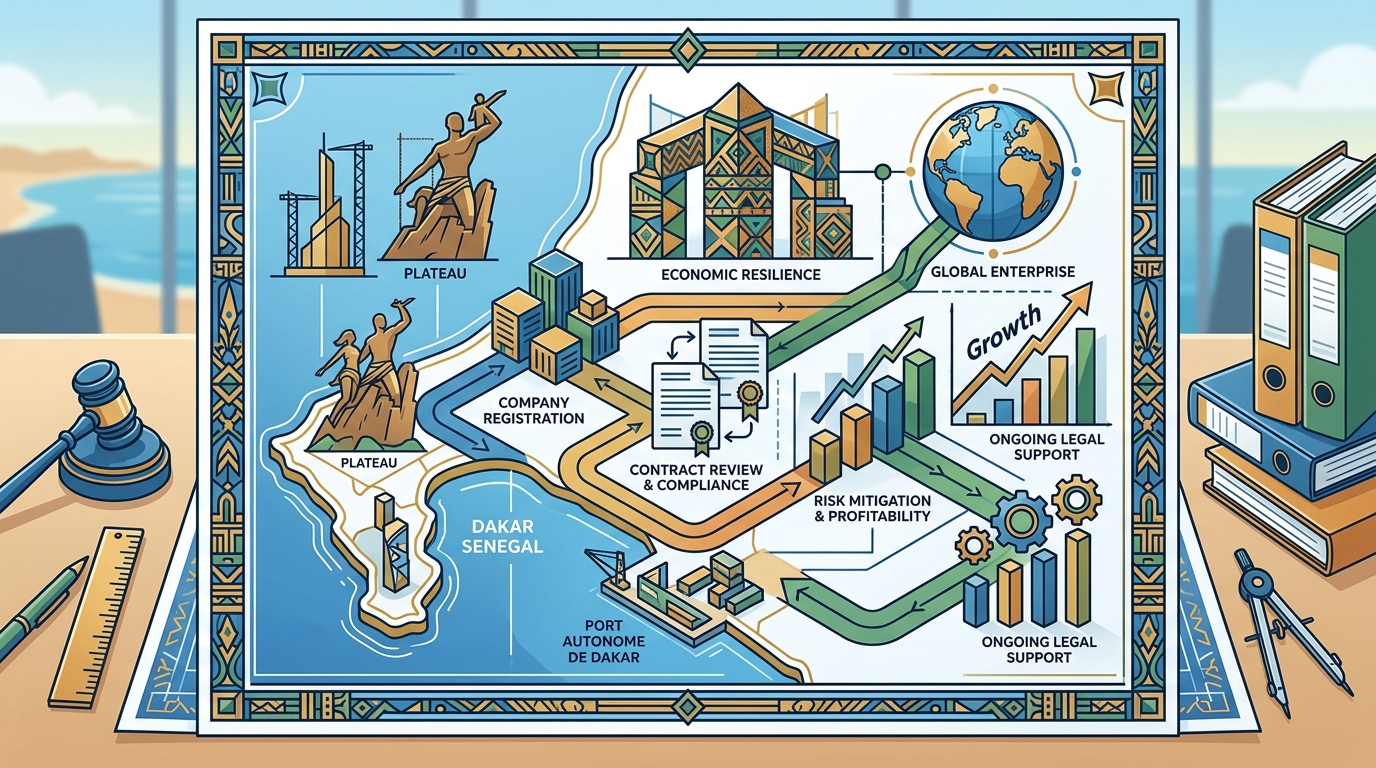
The Registration and Capital Process
Establishing your legal entity involves a rigorous administrative process. The first step is the deposit of share capital into a blocked bank account in Dakar. The amount varies depending on the chosen entity type and the nature of the business. Once the capital is secured, you must file a legal notice in a local newspaper. This public announcement serves to inform creditors and stakeholders of the new entity's existence.
Following the newspaper publication, you must submit a comprehensive dossier to the Centre de Formalités des Entreprises (CFE). This single-window system streamlines the registration process with tax authorities, social security, and commercial courts. The dossier typically includes articles of association, proof of capital deposit, and identification documents for all directors. Navigating this bureaucratic landscape requires precision. Our team ensures that every document meets the strict regulatory standards of the Senegalese government.
Tax Identification and Fiscal Compliance
Post-registration, immediate attention must be paid to fiscal obligations. Every business in Senegal must obtain a NINEA (Numéro d'Identification Nationale des Entreprises et Associations). This unique identifier is essential for all tax filings, customs operations, and official contracts. Without a NINEA, your business cannot legally operate or import goods.
Senegal's tax regime is governed by the General Tax Code. Key obligations include the Corporate Income Tax (IS), Value Added Tax (TVA), and social security contributions. The standard corporate tax rate is 30%, though specific incentives may apply to businesses in designated economic zones or sectors. Proper fiscal structuring is not merely a compliance issue but a strategic advantage. We offer specialized guidance on Senegalese tax law for businesses and investors to optimize your financial position.
Labor Law and Work Permit Requirements
Hiring staff in Dakar requires strict adherence to the Senegalese Labor Code. The standard employment contract is the CDI (Contrat à Durée Indéterminée), which offers strong protections to employees. Employers must also register with the National Social Security Fund (CNPS) and contribute to various social welfare schemes.
For foreign executives and specialists, obtaining a work permit is a prerequisite. The process involves demonstrating that the role cannot be filled by a local candidate. This often requires a thorough justification of the employee's specialized skills. The procedure for obtaining a business visa and work authorization is complex and time-sensitive. Our immigration law experts manage this process to ensure your team can deploy without delay.
Protecting Intellectual Property Assets
In the digital economy, protecting your brand and innovations is paramount. Senegal is a member of the African Intellectual Property Organization (OAPI). This means that a single registration in OAPI protects your trademarks and patents across all member states, including Senegal. Registering your brand locally prevents counterfeiting and unauthorized use.
Data protection is another critical area. Senegal has enacted laws governing the processing of personal data, aligning with international standards. Businesses must implement robust data security protocols and register with the National Agency for the Protection of Personal Data. Failure to comply can result in significant fines. We assist clients in securing intellectual property and ensuring regulatory compliance in Dakar.
Key Takeaways for Investors
- OHADA Compliance: All business operations must adhere to the harmonized laws of the OHADA region to ensure legal validity across West Africa.
- Entity Selection: Choose between SARL for flexibility or SA for large-scale capital requirements based on your investment strategy.
- NINEA Requirement: Obtain your National Enterprise Identification Number immediately to enable tax filing and customs clearance.
- Capital Deposit: Share capital must be deposited in a blocked bank account before the legal notice is published.
- Work Permits: Foreign employees require specific work visas and permits, which must be processed before arrival in Dakar.
- OAPI Protection: Register trademarks and patents through OAPI to secure intellectual property rights across 17 African nations.
- Data Privacy: Implement strict data protection measures compliant with Senegalese law to avoid regulatory penalties.
Frequently Asked Questions
How long does it take to register a company in Dakar?
The registration process typically takes between two to four weeks, depending on the complexity of the corporate structure and the efficiency of the local administrative bodies.
What is the minimum share capital required for a SARL?
The minimum share capital for a SARL in Senegal is determined by law and must be fully paid up before the company is registered. It is generally set at a specific threshold to ensure financial credibility.
Do I need a local partner to start a business in Senegal?
Foreign investors are not legally required to have a local partner, but having one can facilitate navigation of local administrative procedures and cultural nuances.
What taxes apply to foreign-owned businesses in Dakar?
Foreign-owned businesses are subject to the same tax regime as local companies, including Corporate Income Tax, VAT, and social security contributions, with no additional surcharges solely based on ownership.
How can I protect my brand in West Africa?
You can protect your brand by registering your trademark with the African Intellectual Property Organization (OAPI), which provides protection in Senegal and other member states.
What is the role of the CFE in business creation?
The CFE (Centre de Formalités des Entreprises) acts as a single-window service center that processes the registration of new businesses with various government agencies simultaneously.
Are there incentives for investing in specific sectors?
Yes, Senegal offers various fiscal and customs incentives for investments in priority sectors such as agriculture, energy, and digital infrastructure under the Senegal Emergence Plan.
Secure Your Investment Today
Starting a business in Dakar offers immense potential, but it demands rigorous legal preparation. Sunulex Lawyers provides the strategic guidance and operational expertise necessary to navigate the complexities of OHADA law, fiscal compliance, and regulatory frameworks. Do not leave your investment to chance. Contact our team to schedule a consultation and begin your journey to success in West Africa. Visit our contact page to discuss your project with our experts.