

Dakar is rapidly emerging as one of West Africa's most attractive cities for entrepreneurs and foreign investors. Thanks to political stability, a harmonized OHADA legal framework, and a government-backed one-stop shop for registration, launching a company here is faster than in most Sub-Saharan African markets. Whether you are a Senegalese founder, a European expatriate, or a Chinese or Russian investor eyeing the ECOWAS market, understanding the legal and administrative steps is essential. This guide walks you through every stage, from choosing your entity type to opening your doors for business, so you can move forward with confidence.
Why Dakar Is a Strategic Business Destination
Senegal is a strategic destination for international investors in West Africa. The country offers recognized political stability, a growing economy, and a legal framework harmonized by OHADA (Organisation for the Harmonisation of Business Law in Africa). Dakar concentrates nearly 80% of the country's economic activity and 90% of its industrial base, making it the undisputed commercial hub of the nation.
The startup ecosystem is growing too. According to Tracxn data, Senegal has over 930 startups, with 215 funded companies that have collectively raised $572 million. The government's investment incentives, including special economic zones with a reduced 15% corporate tax rate, add further appeal.
Choosing the Right Business Entity
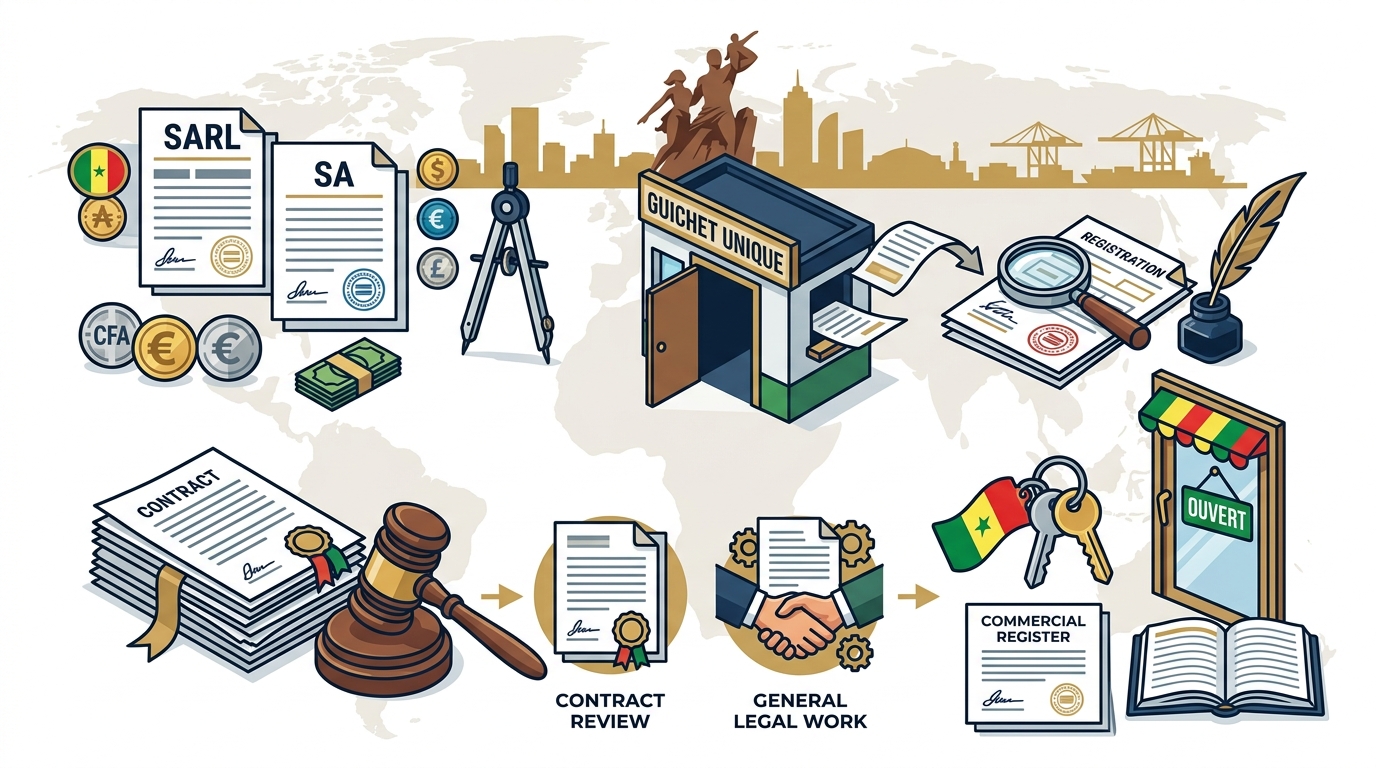
OHADA is the supranational legal system that governs company law across 17 African member states, including Senegal. Before registering, you must decide which corporate structure fits your goals. The most common options in Dakar are listed below.
SARL (Société à Responsabilité Limitée)
A SARL is a limited liability company suitable for small to medium-sized businesses and family ventures. It requires at least one shareholder and is managed by one or more natural persons called gérants. There is no significant minimum capital requirement under OHADA law, and foreign investors can own 100% of the company. This is the most popular structure for entrepreneurs entering Senegal.
SA (Société Anonyme)
An SA is a public limited company designed for larger operations and capital-intensive projects. The minimum share capital is XOF 10 million (approximately EUR 15,000), and at least one quarter must be paid up at incorporation. An SA must have a board of directors if its shares are publicly traded.
SAS (Société par Actions Simplifiée)
An SAS is a simplified joint-stock company introduced in the 2014 revision of the OHADA Uniform Act. It can be registered with no minimum share capital and offers flexible governance tailored to shareholders' needs. This structure is increasingly favored for private equity and joint ventures. If you need guidance on which entity best fits your project, consult a business law firm in Senegal before filing.
Step-by-Step Registration Process
Senegal's Investment Promotion Agency, known as APIX, operates a one-stop shop called the Bureau d'Appui à la Création d'Entreprises (BCE) in downtown Dakar. This facility merged seven formerly separate procedures into a single streamlined process.
Step 1: Draft and Notarize Articles of Association
Engage a notary to draft your company's statutes (statuts). The notary certifies the articles of association and the subscription declaration. For simple SARLs, APIX offers a standard template that can reduce notary involvement. Notary fees typically range from XOF 200,000 to XOF 400,000 depending on complexity.
Step 2: Deposit Share Capital
Open a corporate bank account at a local institution such as CBAO, Société Générale Sénégal, or Ecobank and deposit the initial share capital. The bank issues a subscription certificate confirming the deposit. This step is mandatory before formal registration.
Step 3: Register at the APIX One-Stop Shop
Submit your notarized documents to the BCE. Four agencies are represented on-site to handle registration simultaneously: the tax authority for bylaw registration, the Commercial Registry (RCCM), the NINEA office for your company identification number, and the labor authority. The Sunulex team regularly assists clients through this process to ensure complete filings on the first attempt.
Costs and Timeline at a Glance
| Item | Estimated Cost (XOF) | Timeline |
|---|---|---|
| Notary fees (SARL) | 200,000 - 400,000 | 1 - 3 days |
| Registration fees (capital under XOF 10M) | 27,000 | Included in BCE |
| Court Registrar fees | 30,000+ | Included in BCE |
| APIX one-stop shop processing | Included above | 24 - 48 hours |
| Total estimated (simple SARL) | ~260,000 - 460,000 | 2 - 10 days |
For a foreign-owned LLC, the overall process involves roughly 5 procedures and takes about 10 days in Dakar, making it one of the fastest in Sub-Saharan Africa according to the U.S. Department of Commerce.
Tax Registration and Ongoing Compliance
Once your RCCM and NINEA are issued, you must file a declaration of existence with the tax office (DGID). The standard corporate tax rate in Senegal is 30% of taxable profit. Companies operating in special economic zones or qualifying as Free Export Companies may benefit from a reduced rate of 15%.
Employer registration with IPRES (retirement pensions) and the Caisse de Sécurité Sociale (CSS) is mandatory if you hire staff. VAT at 18% applies to most goods and services. Staying compliant from day one avoids penalties and protects your ability to win contracts. For tax structuring advice tailored to your situation, explore Sunulex's corporate and tax law services.
Special Considerations for Foreign Investors
Senegal allows full foreign ownership with no local partner requirement. However, non-Senegalese residents need a visa or residence permit to live and operate a business in Dakar. EU nationals can enter visa-free for up to 90 days, but long-term residency requires proof of income and a registered business.
Foreign companies engaged in international trade must also obtain an import-export card from APIX or a business court. If you are setting up a branch (succursale) of a foreign corporation, OHADA rules historically required conversion to a local entity within two years, though waivers exist. Understanding these nuances is critical, and a firm with dual Africa-Europe expertise, like Sunulex Lawyers, can bridge those regulatory gaps.
Intellectual property protection is another priority for foreign entrants. Registering trademarks and patents through the OAPI system safeguards your brand across the region. Learn more about strategies for protecting your intellectual property in Senegal.
Key Takeaways
- Dakar concentrates roughly 80% of Senegal's economic activity, making it the natural base for new ventures.
- The SARL is the most popular entity for entrepreneurs, offering 100% foreign ownership and low setup costs.
- APIX's one-stop shop (BCE) can process company registration in as little as 24 to 48 hours.
- Total formation costs for a simple SARL typically range from XOF 260,000 to XOF 460,000.
- The standard corporate tax rate is 30%, with reduced rates available in special economic zones.
- Foreign investors face no local partner requirement but need visas for long-term residency.
- Engaging a business law firm early reduces delays and ensures first-time filing accuracy.
Frequently Asked Questions
What is the fastest way to register a business in Dakar?
The fastest route is through the APIX one-stop shop (BCE) in downtown Dakar. It consolidates tax registration, commercial registry, company ID, and labor registration into a single visit. Processing can take as little as 24 to 48 hours for a domestic SARL.
Can a foreigner own 100% of a company in Senegal?
Yes. Senegal allows full foreign ownership with no mandatory local partner. A foreign investor can form and own 100% of a SARL, SA, or SAS.
What is OHADA and why does it matter?
OHADA is the Organisation for the Harmonisation of Business Law in Africa. It provides a unified legal framework for company law, commercial transactions, and dispute resolution across 17 member states, including Senegal. This harmonization simplifies cross-border business in West and Central Africa.
How much does it cost to start a SARL in Senegal?
For a SARL with capital under XOF 10 million, expect registration fees of about XOF 27,000, court registrar fees of XOF 30,000, and notary fees of XOF 200,000 to XOF 400,000. Total costs usually fall between XOF 260,000 and XOF 460,000.
Do I need a notary to form a company?
In most cases, yes. Notarization of the articles of association is mandatory for SARLs and SAs. However, APIX provides a standard template for simple SARLs that may reduce notary involvement.
What tax incentives are available for investors?
Senegal offers special economic zone benefits, including a reduced 15% corporate tax rate and customs duty exemptions for qualifying investments. The Investment Code provides additional incentives for approved projects in priority sectors such as agriculture, renewable energy, and tourism.
How long does the entire process take for a foreign company?
Forming a foreign-owned LLC in Dakar takes approximately 5 procedures and 10 days. This includes notarization, capital deposit, one-stop shop registration, and any additional import-export card requirements.
What ongoing obligations does a new company have?
After registration, companies must register with IPRES and CSS for employee benefits, file annual tax returns with the DGID, maintain OHADA-compliant accounting records, and renew any sector-specific licenses as required.
Get Professional Legal Support
Starting a business in Dakar is straightforward when you have the right guidance. From entity selection and articles of association to tax structuring and regulatory compliance, every decision has legal implications. Contact Sunulex Lawyers today for a consultation on setting up your company in Senegal with confidence.