

Dakar is the economic engine of Senegal, concentrating roughly 80% of the country's economic activity on a single peninsula. Whether you are a Senegalese entrepreneur, a French or Belgian investor, or a company from China or Russia exploring West Africa, setting up a business in Dakar follows a clear legal pathway governed by the OHADA framework. This guide walks you through every essential step, from choosing your legal structure to obtaining your tax identification number, so you can launch with confidence and full compliance.
Why Dakar Is a Strategic Business Destination
Senegal is one of the most politically stable countries in Sub-Saharan Africa, with peaceful transitions of power since independence. The CFA Franc (XOF) is pegged to the Euro, providing currency stability that appeals to European investors. Major offshore oil and gas discoveries at Sangomar and Grand Tortue Ahmeyim are transforming Senegal into a future energy exporter, creating supply-chain opportunities across multiple sectors.
The government actively encourages foreign investment. Investing in Senegal means accessing the ECOWAS market of roughly 400 million consumers and the eight-country WAEMU monetary union. Senegal also launched its Digital Senegal 2025 initiative, offering tax benefits to attract tech-driven entrepreneurship.
Choose the Right Legal Structure
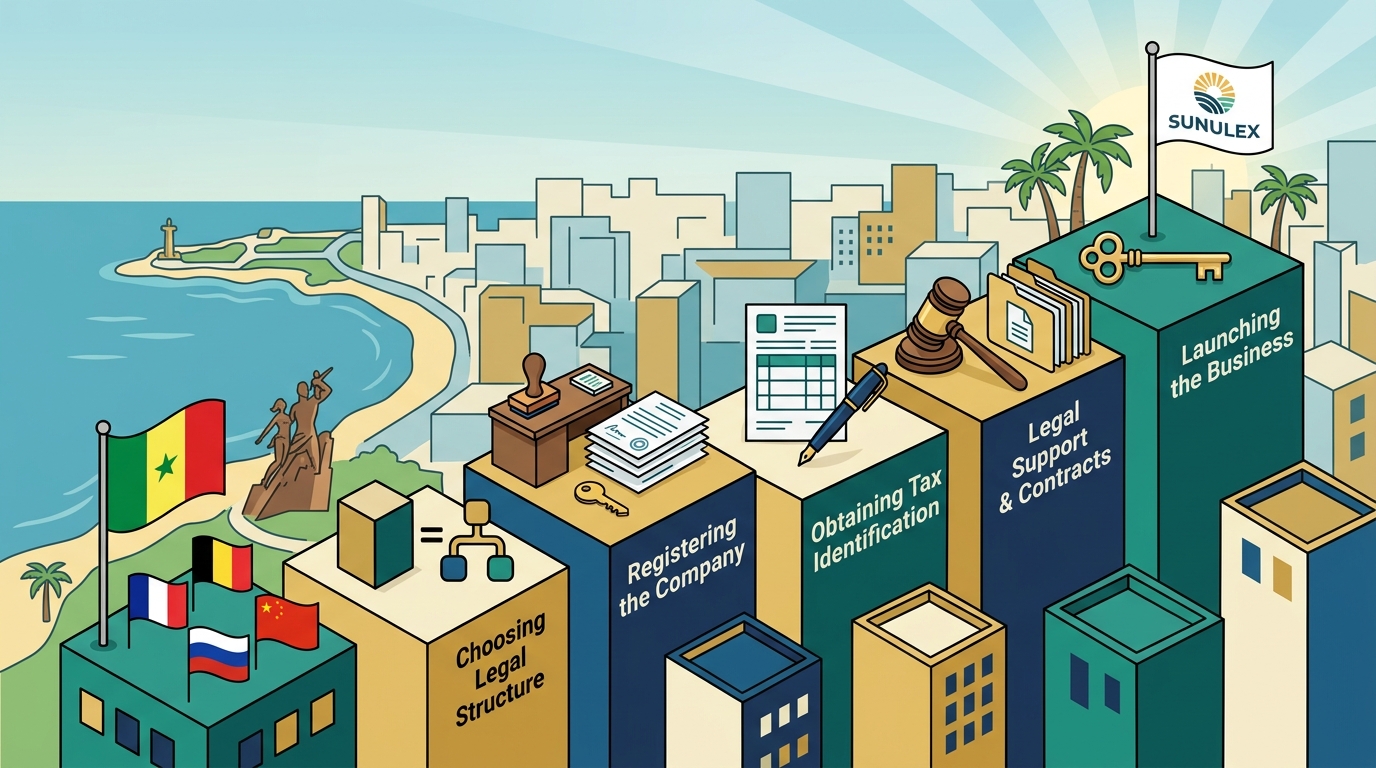
Your first decision is selecting the corporate form that fits your goals. OHADA is the Organisation pour l'Harmonisation en Afrique du Droit des Affaires, a treaty framework that harmonizes business law across 17 African states including Senegal. Common structures available in Dakar include:
SARL (Société à Responsabilité Limitée)
A SARL is a limited liability company where each shareholder's risk is capped at the amount of capital contributed. It is the most popular choice for foreign entrepreneurs because of its flexibility and limited liability protection. You can form a single-shareholder SARL or include multiple partners.
SA (Société Anonyme)
An SA is a public limited company suited for larger projects requiring significant capital or multiple investors. It has stricter governance requirements, including a board of directors.
Branch (Succursale) or Sole Proprietorship
A branch office lets a foreign parent company operate in Senegal without creating a separate legal entity. A sole proprietorship is simpler but offers no liability shield. The table below compares the key options.
| Structure | Liability | Minimum Capital | Best For |
|---|---|---|---|
| SARL | Limited to contributions | XOF 100,000 | SMEs, foreign startups |
| SA | Limited to shares | XOF 10,000,000 | Large enterprises, IPO track |
| Branch (Succursale) | Parent company liable | None required | Market testing by foreign firms |
| Sole Proprietorship | Unlimited personal liability | None required | Individual traders |
Core Registration Steps at the APIX One-Stop Shop
APIX is Senegal's Agency for Investment Promotion and Major Works. Since 2007, it has operated a one-stop shop called the Bureau d'Appui à la Création d'Entreprises (BCE) in downtown Dakar, merging what previously required seven separate procedures into a single visit. Here is the step-by-step process:
Step 1: Name Reservation and Notarization
Reserve your company name with the Commercial Court. Then, engage a Senegalese notary to draft and notarize your Articles of Association (statuts). Using a notary is mandatory for most entity types. In practice, notary fees range from XOF 200,000 to XOF 400,000 depending on the complexity of the formation deed.
Step 2: Deposit Capital and Register
Open a corporate bank account at a local institution such as Société Générale Sénégal, CBAO, or Ecobank and deposit your initial share capital. Then submit your documents to the APIX one-stop shop. At the BCE, four agencies process your file simultaneously: the tax authority registers your bylaws, the Commercial Registry (RCCM) records the company, the NINEA office issues your national business identification number, and the labour authority registers your workforce.
Step 3: Collect Your RCCM and NINEA
After processing, you receive your Registre du Commerce et du Crédit Mobilier (RCCM) number and your Numéro d'Identification Nationale des Entreprises et Associations (NINEA). The RCCM is your commercial registration, while the NINEA is your unique tax and administrative identification number.
Costs and Timeline
Forming a business in Dakar is among the fastest processes in Sub-Saharan Africa. According to U.S. Department of Commerce data, the BCE reduced registration time from 58 days to an average of two. For a foreign-owned LLC, the complete process typically involves five procedures over approximately 10 days.
| Fee Type | Amount (XOF) | Notes |
|---|---|---|
| Registration fees (statuts + declaration) | 27,000 | For capital under XOF 10,000,000 |
| Court Registrar fees | 30,000+ | XOF 30,000 base + XOF 90 per additional million |
| Notary fees | 200,000 - 400,000 | Varies by service scope |
| Total estimate (excl. share capital) | ~257,000 - 457,000 | Roughly EUR 400 - 700 |
Senegal allows 100% foreign ownership with no requirement for a local partner, making Dakar particularly attractive for international entrepreneurs.
Tax Registration and Social Security Enrollment
After incorporation, register with the Direction Générale des Impôts et des Domaines (DGID) for corporate income tax and VAT. The standard corporate tax rate in Senegal is 30% of taxable profit. Companies in Special Economic Zones may qualify for a reduced rate of 15%.
You must also enroll employees with IPRES (the national pension fund) and the Caisse de Sécurité Sociale (CSS) for workplace insurance. Payroll withholding obligations apply from the first hire. If your project qualifies, APIX can facilitate investment incentives including customs duty exemptions and CIT reductions for up to 25 years.
Why You Need Legal Support From Day One
Navigating OHADA regulations, notarial requirements, and Senegalese tax law is complex, especially for foreign investors unfamiliar with French-language procedures. A specialized business law firm in Dakar can draft compliant articles of association, structure governance to protect minority shareholders, and coordinate cross-border tax planning.
Sunulex Lawyers brings dual Africa-Europe expertise, assisting Senegalese companies and international investors alike in company formation, intellectual property protection, contract review, and regulatory compliance across the OHADA zone. Early legal guidance prevents costly errors and accelerates your time to market.
Key Takeaways
- Dakar concentrates 80% of Senegal's economic activity and is the primary hub for company formation.
- The SARL (limited liability company) is the most popular structure for foreign entrepreneurs in Senegal.
- APIX's one-stop shop (BCE) can process company registration in as little as two days.
- Total formation costs for a basic SARL start around XOF 257,000 (approximately EUR 400), excluding share capital.
- Senegal permits 100% foreign ownership with no local partner requirement.
- The standard corporate tax rate is 30%, with reduced rates available in Special Economic Zones.
- Engaging a business law firm experienced in OHADA law is essential to ensure compliance and avoid delays.
Frequently Asked Questions
What is the fastest way to register a company in Dakar?
The fastest route is through the APIX one-stop shop (Bureau d'Appui à la Création d'Entreprises), which consolidates tax registration, commercial registration, NINEA issuance, and labour registration into a single process that can be completed in about two days.
Can a foreigner own 100% of a business in Senegal?
Yes. Senegalese law allows full foreign ownership without requiring a local partner. Foreign investors receive the same treatment as domestic entrepreneurs under the OHADA framework.
What is the minimum capital to start a SARL in Senegal?
The minimum share capital for a SARL under OHADA law is XOF 100,000 (approximately EUR 150). This amount must be deposited with a notary or a local bank before registration.
How much does it cost to incorporate a company in Dakar?
Excluding share capital, basic formation costs range from XOF 257,000 to XOF 457,000 (roughly EUR 400 to EUR 700). This includes registration fees, court registrar fees, and notary charges.
Do I need a notary to form a company in Senegal?
Yes, using a Senegalese notary is mandatory for most entity types, including the SARL and SA. The notary drafts and certifies the Articles of Association and handles the capital deposit certificate.
What is OHADA and why does it matter?
OHADA (Organisation pour l'Harmonisation en Afrique du Droit des Affaires) is a treaty system that standardizes business law across 17 African member states. It provides a predictable legal framework for company formation, commercial transactions, and dispute resolution in Senegal.
What taxes will my company pay in Senegal?
The standard corporate income tax rate is 30%. VAT applies at 18%. Companies in approved Special Economic Zones may benefit from a reduced 15% corporate tax rate and customs duty exemptions. Withholding taxes apply on dividends (10%), interest (8-16%), and royalties (20%).
How long does the entire process take for a foreign-owned company?
A foreign-owned LLC formation in Dakar typically involves five procedures and takes approximately 10 days from start to finish, making it one of the fastest processes in Sub-Saharan Africa.
Ready to Launch Your Business in Dakar?
Starting a company in Senegal is straightforward when you have the right legal partner. Sunulex Lawyers provides end-to-end support for entrepreneurs and investors setting up in Dakar and across the OHADA zone. Contact Sunulex today to schedule a consultation and get your business registered with confidence.