

Establishing a commercial entity in Dakar requires navigating a structured regulatory framework designed to streamline investment while ensuring compliance with Senegalese economic laws. According to recent World Bank data on ease of doing business in West Africa, the average time to register a company has decreased significantly, yet the procedural complexity remains high for foreign investors unfamiliar with local protocols. This guide outlines the precise operational steps required to launch your enterprise legally and efficiently in Senegal's capital.
Phase 1: Strategic Preparation and Naming
Before filing any documents, you must define the legal structure of your enterprise. In Senegal, the most common structures for small to medium enterprises are the SARL (Société à Responsabilité Limitée) and the SA (Société Anonyme). The choice depends on the number of shareholders and capital requirements. A SARL is generally preferred for startups due to its flexibility and lower administrative burden.
The first administrative hurdle is reserving your company name. You must submit a Certificat Négatif (Negative Certificate) to the Centre de Formalités des Entreprises (CFE) or the relevant regional authority. This document proves that your proposed business name is not already in use. The process typically takes 24 to 48 hours. It is critical to choose a name that reflects your brand identity while adhering to local naming conventions.
For detailed insights on corporate structuring, review our corporate structuring services to ensure your legal framework aligns with long-term growth goals.
Phase 2: Official Registration with RCCM
Once the name is reserved, the core of your legal existence is the Registre du Commerce et du Crédit Mobilier (RCCM). This registry serves as the official proof of your company's existence. The RCCM number is mandatory for opening bank accounts, signing contracts, and hiring staff.
The registration process involves submitting a comprehensive dossier. This includes the articles of association, proof of address, and identification documents for all shareholders and directors. The CFE acts as a one-stop shop for many of these submissions, reducing the need to visit multiple government offices. According to the Organisation for Economic Co-operation and Development (OECD), digital transformation in West African registries has improved processing times by approximately 30% over the last five years.
Understanding the nuances of the RCCM is vital. For a deeper dive into registration requirements, visit our RCCM registration guide.
Phase 3: Tax Identification and Compliance
Simultaneously with RCCM registration, you must obtain a Numéro d'Identification Statistique (NIS) and a Numéro d'Identification Fiscale (NIF). The NIF is your unique tax identifier and is essential for filing annual returns and paying corporate taxes. Senegal's tax authority, the Direction Générale des Impôts et des Domaines (DGID), manages these registrations.
Corporate tax rates in Senegal vary based on your revenue brackets and sector. Generally, the standard corporate income tax rate is 30% for large enterprises, while small and medium-sized enterprises may benefit from reduced rates or tax holidays under specific investment codes. It is crucial to consult with a local tax expert to determine your applicable rate. Data from the International Monetary Fund indicates that tax compliance costs can account for up to 5% of a new business's initial capital in emerging markets.
To understand your potential tax liabilities, explore our tax advisory services tailored for foreign investors.
Phase 4: Sector-Specific Permits and Licenses
Depending on your industry, additional permits may be required. For example, businesses in hospitality, food service, or healthcare must obtain health and safety certifications from local municipal authorities. Technology and digital service providers may need to register with the Agence Nationale de Réglementation des Télécommunications (ART).
Failure to secure these specific licenses can result in heavy fines or operational shutdowns. The regulatory landscape in Dakar is dynamic, with new decrees issued regularly to attract foreign direct investment. Staying updated is not optional; it is a core operational requirement. Recent reports from the African Development Bank highlight that regulatory clarity is a top priority for investors in the region.
For industry-specific compliance checklists, refer to our compliance checklist resource.
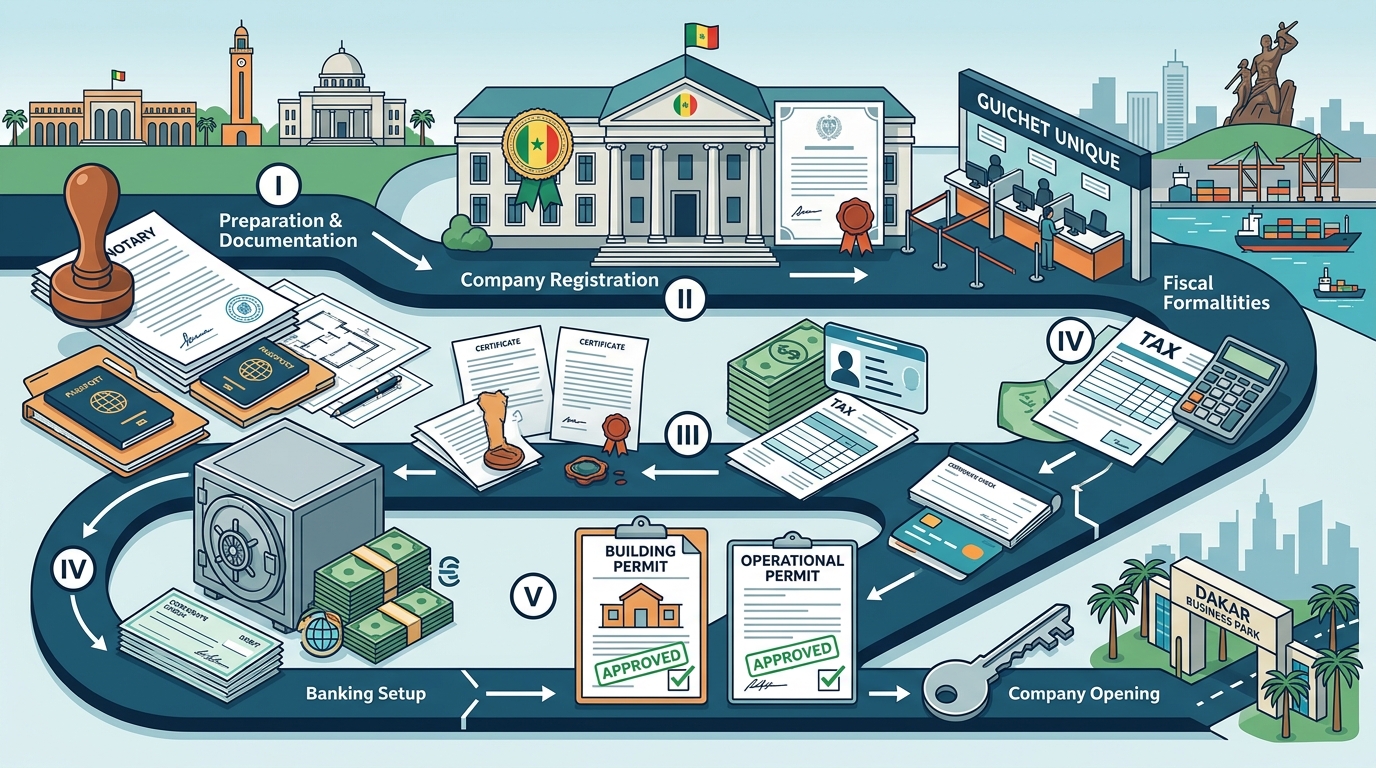
Phase 5: Corporate Banking and Capital
Opening a corporate bank account is a critical step. You must deposit the minimum share capital as defined in your articles of association. Major banks in Dakar, such as Ecobank, BICIS, and Banque Atlantique, offer specialized accounts for foreign investors. The process requires your RCCM, NIF, and identification documents.
Foreign investors can repatriate profits and capital under Senegal's liberalized exchange regime, governed by the Central Bank of West African States (BCEAO). This framework ensures that your investment is protected and that financial transactions are transparent. According to the BCEAO, the banking sector in the WAEMU region has seen a 15% increase in digital transaction volumes, facilitating easier business operations.
Learn more about financial infrastructure in our WAEMU financial system overview.
Phase 6: Social Security and Labor Compliance
Once you hire your first employee, you must register with the Caisse Nationale de Prévoyance Sociale (CNPS). This social security organization manages contributions for health, pension, and family allowances. Employers are required to deduct a portion of employee salaries and contribute an additional employer share.
Labor laws in Senegal are governed by the Labor Code, which outlines rights and obligations for both employers and employees. Contracts must be in French, and specific clauses regarding working hours, leave, and termination must be included. Non-compliance can lead to significant legal penalties. The International Labour Organization (ILO) notes that labor law enforcement has strengthened in Senegal, providing greater protection for workers.
For guidance on employment contracts, check our HR compliance services.
Key Takeaways
- The RCCM is the primary legal document proving your company's existence in Senegal.
- A Certificat Négatif is required to reserve your business name before registration.
- The NIF is your mandatory tax identification number for all fiscal interactions.
- Corporate tax rates can reach 30% for large enterprises, with incentives for SMEs.
- Registration with the CNPS is mandatory upon hiring the first employee.
- Foreign investors can repatriate profits under the BCEAO exchange regime.
- Using a local CFE can significantly reduce administrative processing time.
Frequently Asked Questions
How long does it take to register a business in Dakar?
The process typically takes between 2 to 4 weeks, depending on the completeness of your documentation and the efficiency of the CFE. Digital submissions can accelerate this timeline.
Can a foreigner own 100% of a company in Senegal?
Yes, foreign investors can own 100% of most business entities in Senegal, including SARLs and SAs, without requiring a local partner.
What is the minimum capital required to start a business?
For a SARL, there is no strict minimum capital requirement by law, but it must be sufficient to cover initial operational costs. For an SA, the minimum is typically 10 million CFA francs.
Is a local address required for registration?
Yes, you must provide a registered office address in Senegal. This can be a physical office or a virtual office service that complies with local regulations.
What are the main taxes for new businesses?
The primary taxes include Corporate Income Tax (IS), Value Added Tax (VAT), and Professional Tax (TP). SMEs may qualify for reduced rates or exemptions.
Do I need a visa to start a business?
Foreign entrepreneurs may need a business visa or residence permit. It is advisable to consult with an immigration specialist to ensure your status is compliant.
How do I open a corporate bank account?
You will need your RCCM, NIF, articles of association, and ID documents. Most major banks in Dakar offer dedicated services for foreign investors.
What is the role of the CFE?
The Centre de Formalités des Entreprises acts as a one-stop shop to streamline the registration process, reducing the need to visit multiple government offices.
Next Steps
Starting a business in Dakar is a rewarding endeavor that offers access to a growing West African market. However, the regulatory landscape requires precision and local expertise. Avoid common pitfalls by leveraging professional guidance. Contact Sunulex today to schedule a consultation and begin your journey with confidence.