

Common Mistakes When Registering a Foreign Business in Senegal and How to Avoid Them
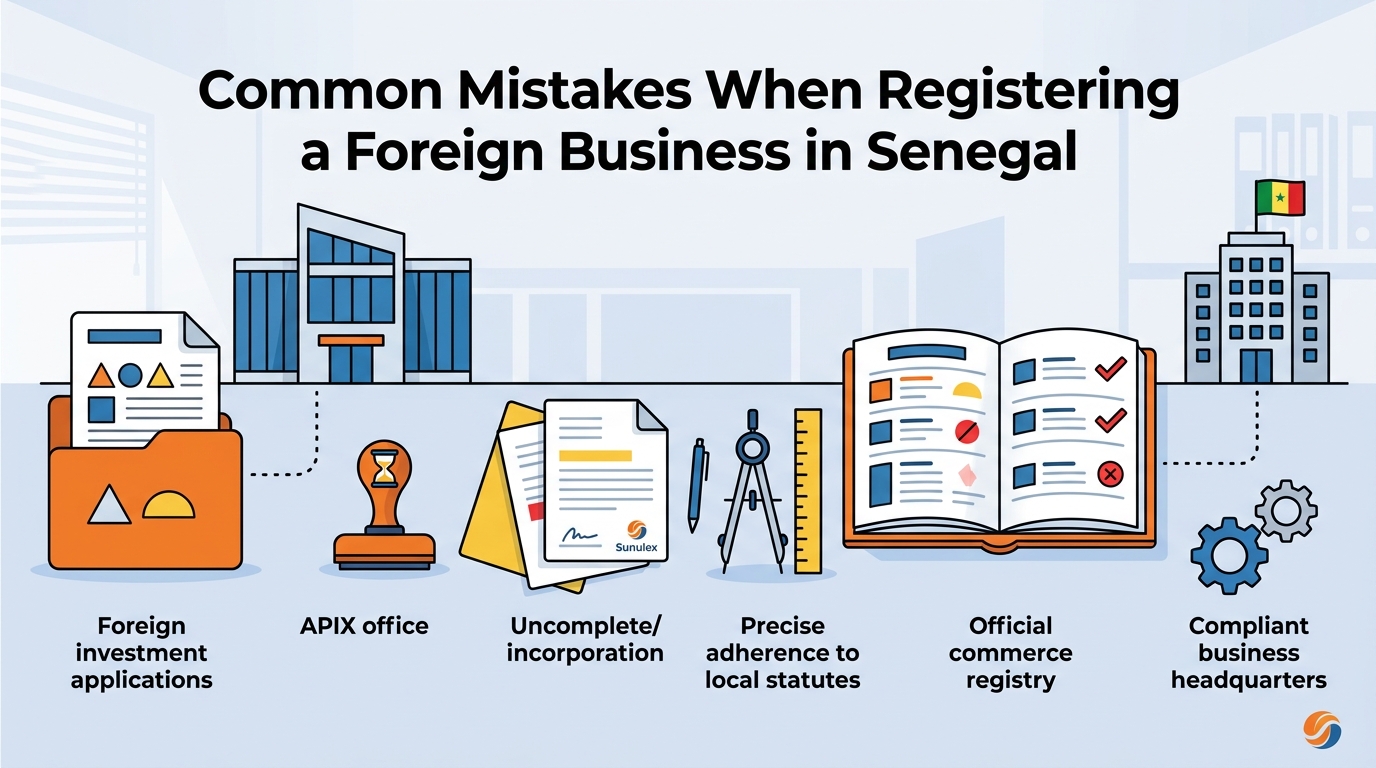
Establishing a commercial presence in West Africa offers significant growth potential, yet the regulatory landscape in Senegal demands precise adherence to local statutes. According to the World Bank's Doing Business reports, navigating the "Starting a Business" indicators in Francophone Africa requires meticulous documentation to avoid administrative bottlenecks. Foreign entrepreneurs often underestimate the complexity of the Agence de Promotion des Investissements (APIX) framework, leading to delays that can stall operations for months. This guide details the critical pitfalls encountered during the incorporation process and provides actionable strategies to ensure a compliant and efficient launch.
Understanding the Role of APIX
The Agence de Promotion des Investissements (APIX) serves as the single-window agency for investment promotion in Senegal. A frequent error among foreign investors is treating APIX as merely an informational resource rather than a mandatory procedural partner. For investments exceeding a specific threshold, APIX approval is a prerequisite for obtaining the Registre de Commerce et du Crédit Mobilier (RCM). Failure to engage with APIX early in the process can result in the rejection of your commercial registration application.
To avoid this, initiate contact with APIX before drafting your final business plan. They provide the Invest in Senegal portal which outlines the exact documentation required for your specific sector. Engaging with their advisory services ensures that your project aligns with national development goals, potentially unlocking tax incentives and customs exemptions. This proactive approach transforms APIX from a bureaucratic hurdle into a strategic ally.
Choosing the Right Legal Entity
Selecting the appropriate legal structure is foundational to your operational success. The most common vehicle for foreign investment is the Société à Responsabilité Limitée (SARL) or the Société Anonyme (SA). A critical mistake is assuming that a foreign branch operates under the same liability protections as a locally incorporated subsidiary. A branch office does not have independent legal personality, meaning the parent company retains full liability for all debts and obligations incurred in Senegal.
For most small to medium-sized enterprises, an SARL is the preferred structure due to its flexibility and lower capital requirements. However, if you plan to seek public funding or list shares, an SA may be necessary. Consult legal experts at Sunulex Corporate Law to evaluate the long-term implications of each structure. The choice impacts everything from profit repatriation to corporate governance standards.
Liability Implications
Understanding the distinction between limited liability and unlimited liability is crucial. In an SARL, shareholders are liable only up to the amount of their capital contribution. This protection is vital for safeguarding personal assets against business risks. Conversely, operating as a sole proprietorship or a simple branch exposes the foreign parent to direct legal action in Senegalese courts.
Navigating Capital Requirements
One of the most significant administrative hurdles is the proof of capital injection. Foreign investors often fail to deposit the required minimum capital into a blocked bank account before submitting their incorporation documents. The law mandates that a certain percentage of the capital must be paid up before the company can be registered. For an SARL, the minimum capital is relatively low, but for an SA, it is significantly higher.
To avoid delays, secure a commitment letter from a local bank confirming the availability of funds. The Basel III standards influence how local banks assess foreign capital flows, so ensure your funds are sourced from compliant jurisdictions. Once deposited, the bank issues a certificate of deposit, which is a mandatory attachment to your incorporation file. Without this certificate, the Greffe du Tribunal will not process your RCMS.
Repatriation Rules
Senegal is part of the West African Economic and Monetary Union (WAEMU), which has specific rules regarding the repatriation of profits. Investors must understand that while capital can be repatriated, it requires proper documentation to prove the initial injection. Keeping detailed records of the capital transfer is essential for future audits and profit distribution.
Tax Compliance and Registration
Tax registration is not an optional step but a parallel mandatory process. Many foreign entrepreneurs register their company with the commercial court but neglect to obtain a Numéro d'Identification Statistique (NIS) and a Numéro d'Identification Nationale (NINEA). These numbers are required for opening a corporate bank account and filing tax returns. Operating without them can lead to severe penalties and the inability to issue valid invoices.
The General Tax Code of Senegal outlines specific obligations for foreign entities. According to the OECD Tax Administration Reports, compliance with local tax laws is increasingly monitored through automated data exchange. Ensure that your accounting system is set up to handle both Francophone accounting standards and international reporting requirements. Engaging a local tax advisor early can help you identify applicable tax treaties between Senegal and your home country.
VAT Implications
Value Added Tax (TVA) registration is required if your annual turnover exceeds a specific threshold. Foreign companies providing digital services to Senegalese residents may also be subject to digital service taxes. Understanding these nuances prevents unexpected liabilities and ensures smooth cash flow management.
Local Representation and Residency
While foreign ownership is permitted in most sectors, certain industries require a local partner or a minimum percentage of Senegalese equity. A common mistake is assuming that 100% foreign ownership is universally applicable. For example, in logistics and certain agricultural sectors, local participation may be incentivized or mandated.
Additionally, the appointment of a local legal representative is often required for service of process and regulatory correspondence. This person acts as the official liaison between the company and government agencies. Without a reliable local representative, communication gaps can lead to missed deadlines and compliance failures. Sunulex provides Legal Advisory Services to help identify suitable local partners or representatives.
Residency Permits
Foreign directors and key executives will need appropriate residency permits to operate legally. The process for obtaining a carte de séjour can be lengthy. Starting this process concurrently with company registration is advisable to avoid operational disruptions.
Document Authentication and Translation
The requirement for document legalization is a frequent source of delay. Foreign documents, such as certificates of incorporation and articles of association, must be apostilled or legalized by the Senegalese consulate in the country of origin. Furthermore, all documents must be translated into French by a sworn translator registered in Senegal.
Errors in translation or missing apostilles are common reasons for file rejection. Ensure that your legal counsel in your home country initiates the legalization process well in advance. The Hague Apostille Convention simplifies this process for member countries, but non-member documents require diplomatic legalization, which is more time-consuming. Precision in documentation is the key to a swift registration process.
Sworn Translators
Only translations certified by a sworn translator (traducteur assermenté) are accepted by the Greffe. Using a general translation service is insufficient and will result in the rejection of your application. Verify the translator's credentials before submitting your file.
Comparison of Legal Structures
| Feature | SARL (Limited Liability Company) | SA (Public Limited Company) | Branch Office |
|---|---|---|---|
| Minimum Capital | Low (Flexible) | High (Fixed) | None |
| Liability | Limited to Contribution | Limited to Shares | Unlimited (Parent Co.) |
| Management | Gérant (Manager) | Directoire & Conseil | Representative |
| Complexity | Low | High | Medium |
| Best For | SMEs & Startups | Large Enterprises | Project-Based Ops |
Key Takeaways
- APIX Engagement: Early consultation with APIX is mandatory for large investments and provides critical incentives.
- Entity Selection: Choose between SARL and SA based on capital needs and liability protection requirements.
- Capital Proof: Deposit minimum capital in a blocked account before registration to avoid Greffe rejection.
- Tax IDs: Obtain NIS and NINEA numbers immediately after incorporation to enable banking and invoicing.
- Local Rep: Appoint a local legal representative to handle regulatory correspondence and residency permits.
- Document Legalization: Apostille or legalize all foreign documents and use sworn translators for French.
- Compliance: Adhere to WAEMU regulations for capital repatriation and tax reporting to avoid penalties.
Frequently Asked Questions
How long does it take to register a foreign business in Senegal?
The registration process typically takes between 4 to 8 weeks, depending on the completeness of the documentation and the efficiency of the APIX and Greffe offices. Delays often occur due to missing apostilles or incorrect translations.
Is a local partner required for 100% foreign ownership?
In most sectors, 100% foreign ownership is permitted. However, specific industries such as logistics, agriculture, and certain service sectors may have restrictions or incentives for local participation. Always verify sector-specific regulations.
What is the minimum capital required for an SARL?
The minimum capital for an SARL is relatively low and flexible, allowing entrepreneurs to start with a modest amount. However, the capital must be fully paid up before registration, and proof must be provided by a local bank.
Do I need a local tax advisor?
While not legally mandatory, engaging a local tax advisor is highly recommended. Senegal's tax code is complex, and local advisors can help you navigate VAT, corporate tax, and potential double taxation agreements.
Can profits be repatriated abroad?
Yes, profits can be repatriated, but they must be declared and taxed in Senegal first. Proper documentation of the initial capital injection is required to facilitate the legal transfer of funds out of the country.
What is the role of the Greffe du Tribunal?
The Greffe du Tribunal is the commercial court registry where the company is officially incorporated. They issue the Registre de Commerce et du Crédit Mobilier (RCM), which is the primary proof of legal existence.
How do I handle document translation?
All foreign documents must be translated into French by a sworn translator registered in Senegal. General translations are not accepted by government authorities.
Start Your Senegalese Venture Today
Navigating the complexities of registering a foreign business in Senegal requires precision, local expertise, and a clear understanding of regulatory frameworks. By avoiding common mistakes and leveraging the right resources, you can establish a solid foundation for growth in this dynamic West African market. Contact Sunulex today to schedule a consultation and ensure your entry into Senegal is seamless and compliant.